
The GLOVE Project
How can I get involved?
For more information, click here. To express your interest in taking part, click here.
If you have an questions about the study, you can also email us at lydia.mcgee@ucdconnect.ie and elena.pavalachi@ucdconnect.ie
What is this research about?
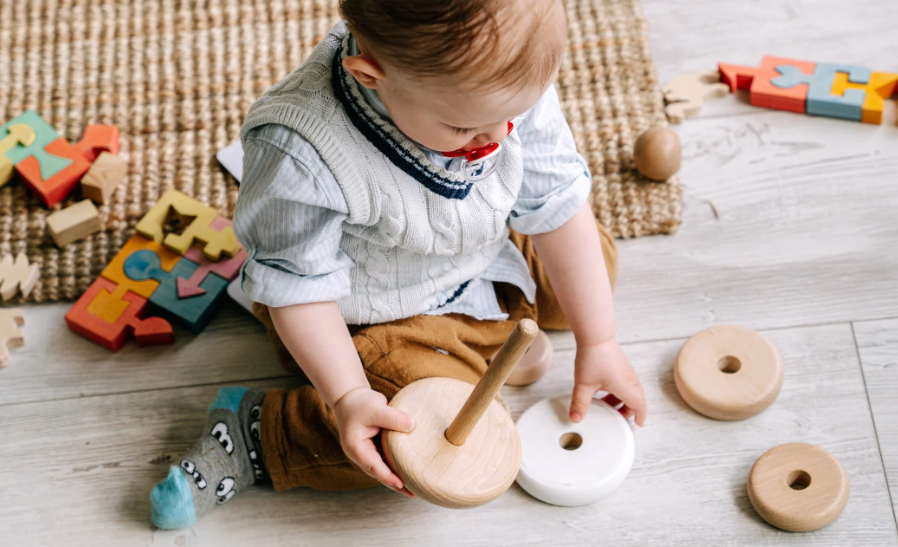
Infancy is a period of rapid development. Babies are growing and learning new skills each day. Motor skills are abilities that allow our bodies to perform movements and actions. During infancy, we learn how to move our bodies, crawl, grasp objects, and play with toys. We also begin to learn about other people.
One of the early ways that babies learn about other people is by watching their actions. Babies seem to be able to predict what someone will do with familiar objects. For example, if you pick up a hairbrush, they can usually predict that you'll brush your hair. They probably learn this from having seen you do the same thing a few times before. Babies seem to get better at predicting other people’s actions when they have experience of doing the same thing. One reason for this might be that they are, in a way, imagining how they would do the same thing.
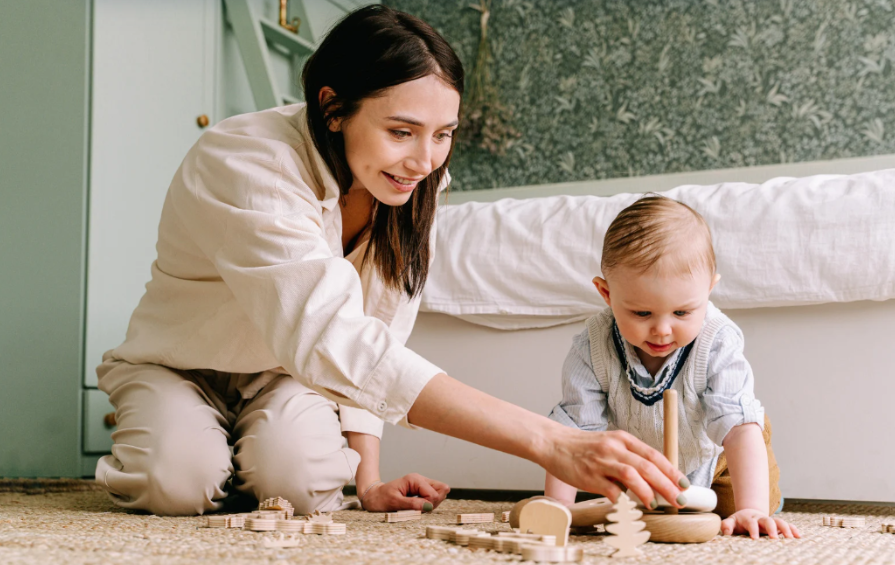
Parts of the brain involved in planning and doing actions behave similarly when we do actions, and when we watch other people do the same thing. Research measuring brain activity in babies using EEG has shown that this happens in babies by nine months of age, with these motor parts of the brain showing a response while babies wait for and watch other people’s actions.
The Current Study
Research has also shown that, for adults and babies, it becomes more difficult to predict another person’s action when we are not in a position to perform the same action ourselves. For example, if a person’s hand movement is limited or restricted, they take longer to figure out what someone else might be reaching for. This provides an interesting insight into how we use our bodies and movements to learn about and interact with other people. Recent work by BAMBI lab leader, Dr Áine Ní Choisdealbha, and her mentor, Prof Andy Meltzoff, suggests that the better a baby’s “fine motor” skills (i.e. skills in using their hands), the harder they find it to predict someone else’s hand actions when their own hand movements are restricted. It is as though, once we know how to do something, we rely a lot on our own experiences of movement and action in learning about other people.
In the Grasping, Learning Observing (GLOVE) project, we want to understand babies’ motor development and how learning motor skills helps their social development. We want to see if the effects of limiting babies’ hand movements while they watch other people’s actions are reflected in their motor brain activity. This would tell us if the effects of restricted movement on babies’ understanding of other people are based on (not) being able to imagine moving their bodies and performing actions in the same way. The ultimate goal is to learn more about the role the motor system plays in early social development, which in turn will tell us if supporting motor skills might have other positive effects on babies’ development. During this study, we will use noninvasive EEG technology to measure what happens in the brain to support motor and social development.
What will happen during the study?
If you decide to take part, we will ask you to visit us at the UCD Babylab, and spend approximately one hour with us. When you arrive, we will ask you to sign a consent form and fill out a questionnaire on motor development. We will ask you to stay with your child throughout your visit.
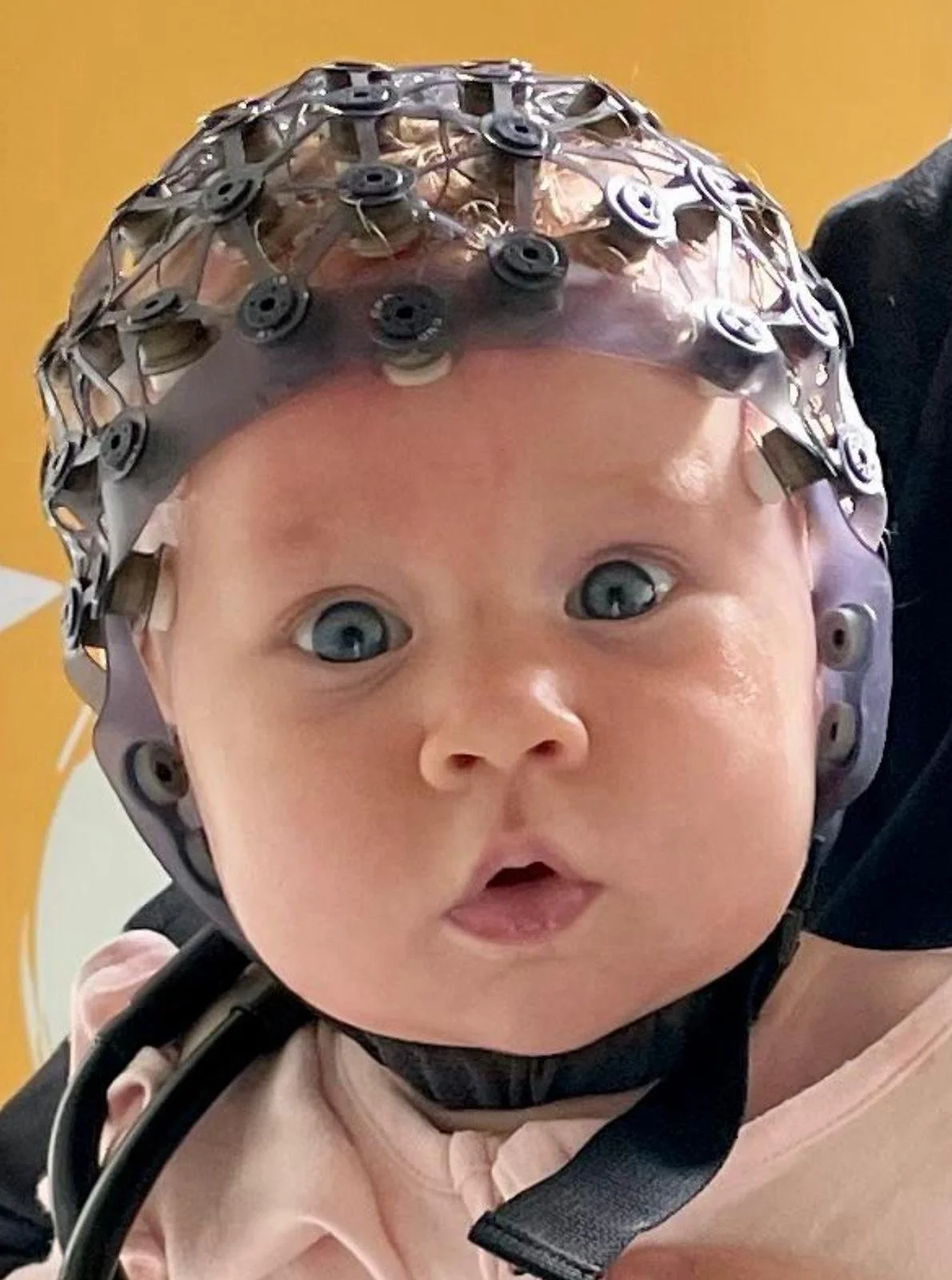
We will measure your baby’s head to find out which size cap for the EEG will be most comfortable. We will soak the cap in a gentle saltwater solution, with a teaspoon of baby shampoo, for a few minutes (this helps the sensors to pick up the brain waves better). While we wait for the cap to be ready, we will ask you to fill out a standardised questionnaire about your baby's motor skills. When the cap is ready, we will gently place it on your baby’s head. We will then give them a few moments to get accustomed to the new feeling of wearing the cap.
Once your baby is comfortable, you will take a seat across the table from one of our researchers, with your baby on your lap. We will spend a few minutes checking the EEG sensors to make sure that we are getting accurate readings. Once everything is set up and ready to go, a researcher will demonstrate some reaching and grasping actions for your baby while we record the EEG.
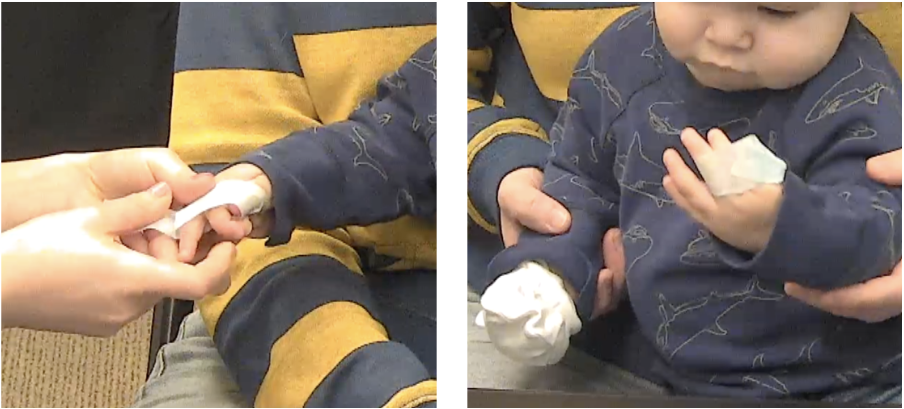
When observing some of these actions, your baby’s hand will be free and unrestricted. Before observing an additional set of actions, we will use some gentle tape, designed to be easily removed from skin, to hold your baby’s thumb alongside their index and middle fingers. We will cover their hands with mittens, to stop them from pulling off the tape. This is to stop the babies’ hands from moving while observing the actor’s actions. The tape used will be hypoallergenic and gentle on the infant’s skin. It is similar to a typical plaster.
We will also record a video of your baby as they watch the actor. This is important as it allows us to see what is happening during the recording when we check the EEG results later (e.g. was the baby wriggling or moving around a lot, were they looking at the screen).