
Why does the UCD Babylab keep contacting me about participating in their research studies?
Tobias Constien, edited by Abigail O’Connell
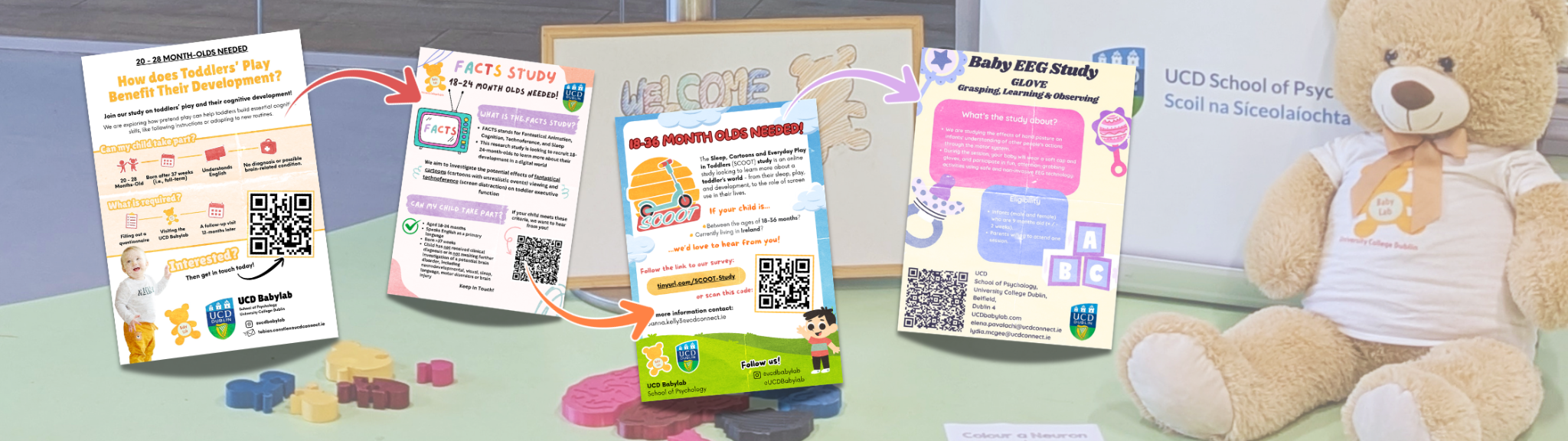
At the UCD Babylab, we are conducting research looking at various elements of children’s early development, like their play, spatial skills, or screen use. Of course, none of this work would be possible without you, the parents and caregivers who generously give their time to fill out a survey, or visit us in person with their child at the lab. You might have seen multiple social media posts from us, recruitment flyers at your local library, or received emails asking you and your child to participate in our studies. We promise, we don’t mean to be annoying, we just want to do good science. Let me tell you why:
There are multiple factors on which a research study is being judged, one of them being its sample size (Bornstein et al., 2013). The sample, that is you and your child, as well as all the other families participating in our research. Generally, the bigger the sample of a study, the more valid are its findings, meaning it can accurately reflect the real world. This is particularly relevant for developmental studies. As you very much know, a multitude of things are influencing children’s everyday behaviour and their development. Moreover, these influences often differ between families or even between siblings. As we are not focusing on one specific child, we need to control for all of these various influences in order to get real results that accurately represent the wider population. Through statistical analyses, we can control for this variability, however, only when we have a large enough sample!
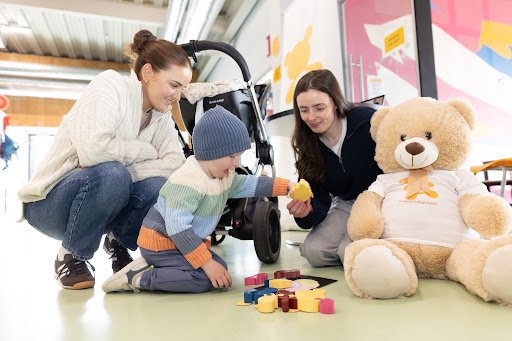
Additionally, it is also important to ensure that a sample is not only large but also diverse. Across psychology, researchers often rely on so-called “convenience” samples, which are, as the name suggests, convenient, meaning they are people or families that are close by and thus easy to recruit (Doebel & Frank, 2023). This often results in research participants being university students or staff. While this might result in a large sample, it also risks that research findings are not readily generalisable to populations beyond the university context. Therefore, we aim to connect with families beyond the UCD campus. It is how we ensure that our findings actually reflect the real world your child is growing up in. We often partner with hospitals, local libraries, crèches, toddler groups or schools to directly engage with families like yours. We also go out to community events like the UCD Festival or the Dublin Maker to inform about our work.
In sum, when we are posting about our research studies, inviting you to participate, or emailing you directly, it is because we want to conduct good research that accurately reflects children’s development in Ireland, and, ultimately, can inform policy and practice to ensure a positive development for all children. Would you like to help us?
References
Bornstein, M. H., Jager, J., & Putnick, D. L. (2013). Sampling in developmental science: Situations, shortcomings, solutions, and standards. Developmental Review, 33(4), 357-370. https://doi.org/10.1016/j.dr.2013.08.003
Doebel, S., & Frank, M. C. (2023). Broadening convenience samples to advance theoretical progress and avoid bias in developmental science. Journal of Cognition and Development, 25(2), 261-272. https://doi.org/10.1080/15248372.2023.2270055